
Have you ever wondered why some digital products, websites, apps, or software simply "work," while others seem confusing and frustrating? It's not just luck.

Have you ever wondered why some digital products, websites, apps, or software simply "work", while others feel confusing and frustrating? It's not pure luck. Behind it lies UX research, or user research.
It is often said that design is problem-solving. But how can you know what problem you are solving if you don't understand the people who need the solution? That's what UX user research is for. It is not a formality, but a process that guides you from guesswork to evidence-based decision-making.
In this text, I explain what UX research is, why it is necessary, and how it helps you build products that not only look good, but are also useful. Whether you are a designer, product manager, entrepreneur, or simply someone interested in how digital products are created, this text will provide you with a clear picture of why this process is important.
What is UX Research? Understanding the Basics
UX research is a systematic process of gathering data about target users, their needs, and behaviors. Its main goal is to understand users in order to create better, more relevant, and more effective products. Instead of relying on assumptions or personal taste, user research allows design and development to be based on real, verifiable information.
Why is UX Research Needed?
Imagine building a house without asking the future residents what their needs are. The result could be a beautiful, but completely non-functional structure. The same applies to digital products. UX research prevents you from making assumptions that can be costly. The main reasons why research is essential are:
- Risk reduction: Creating a product without research is a big risk. You could spend time, money, and resources on something no one wants or understands. User research reduces that risk by ensuring that you build the right product for the right people.
- Increasing user satisfaction: A product designed with an understanding of users is more intuitive and easier to use. This leads to higher satisfaction, loyalty, and, ultimately, the success of the product.
- Resource optimization: When you know what users actually want and what they need, you can focus your efforts on solving those problems, instead of wasting resources on unnecessary features.
- Understanding context: Research helps to understand the broader context in which the product will be used, including user habits, their environment, and daily challenges.

How to Do UX Research: Basic Methods
Qualitative and Quantitative Research
UX research is divided into two main categories:
- Qualitative research: Focuses on understanding the "why" and "how" behind user behavior. Through in-depth interviews and observation, you gather rich, detailed insights.
- Quantitative research: Deals with numbers and statistics. It is used to measure and validate assumptions on a larger sample of users.
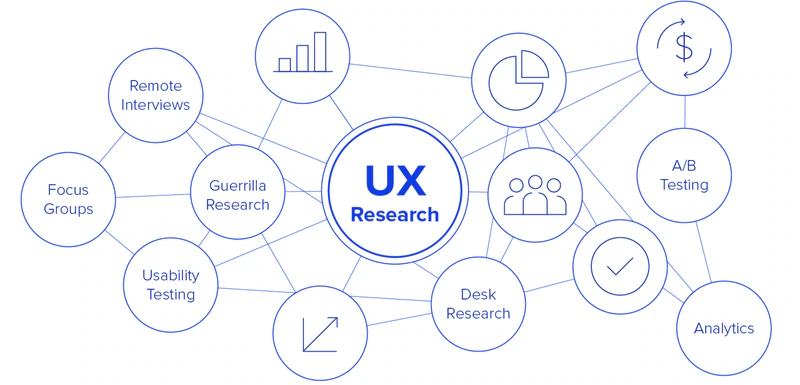
Popular UX Research Methods
- User interviews: One-on-one conversations with users to understand their experiences, needs, and pain points.
- Surveys: A quick and efficient way to gather quantitative feedback from a large number of people.
- Usability testing: Observing users as they perform tasks on a product. This is a key method for uncovering usage problems.
- User diaries (diary studies): Asking users to record their experiences with a product over a certain period of time.
- Competitor analysis: Researching competitors' products to identify strengths, weaknesses, and opportunities in the market.
- Data analysis: Using tools like Google Analytics to understand how users navigate through your site or app.
The Role of Framer in the UX Process
Framer is a tool that has become popular among designers. Although primarily known as a prototyping and design tool, it plays an important role even after the research phases. Once you gather insights through UX research, you can apply them in Framer to quickly create interactive prototypes that simulate a real-life user experience. These prototypes can then be used for testing, validation, and getting additional feedback, closing the research and design loop. Using tools like Framer allows research-based ideas to turn into tangible prototypes that can be tested before moving to the development phase.
The Job of UX Research: Who Does It and Why It Matters?
The job of UX research is often performed by specialized UX researchers, but also by designers, product managers, and even entrepreneurs. Researchers are responsible for planning, conducting, and analyzing research. They are the "detectives" who uncover user needs and barriers.
Regardless of who does it, UX research is important because it connects the team building the product and the people who will use it. It ensures that the user's voice is heard and that their needs are at the center of every design decision.
Questions That UX Research Can Solve
- Who are our users?
- What are their needs and goals?
- What are the obstacles and frustrations they face?
- How does our product fit into their daily lives?
- Does our design solve the right problem?
- Is our product intuitive and easy to use?
Answering these questions allows you to create a product that is not only beautiful, but also functional and useful.
No Good Design Without UX Research
Good design is not just a matter of aesthetics. It directly impacts the success of the product. UX research is behind products that users not only use, but love. It gives you a clear picture of who your users are, what they need, and how you can help them.
Do not skip user research. Use it as the foundation of your design. Whether you use simple methods like interviews or advanced tools like Framer for prototyping, every insight you get will bring you closer to a product that people genuinely need. Good design does not come from luck, but from a deep understanding of the people you are designing for.
After the research is finished, the question arises on which platform to build the product. Find out how to choose the right platform for your business in the text on the differences between Framer, Webflow, and custom code solutions.
How the UX process looks on a real product can be seen in the example of the eNovcanik app UX/UI design.
Have questions or want to find out how UX research can help your product? Write to me or book a free consultation, so we can go through your needs together and find a solution that works for you.