
Personal Brand in 2026
Personal Brand in 2026 | E-E-A-T and AI SEO Strategy
Branding and identity

The year is 2026. The digital world has changed radically. Algorithms and artificial intelligence (AI) generate infinite amounts of text, images, and videos. Mere visibility no longer brings clients. Perfectly polished profiles on social media are losing the battle against real, imperfect human experience.
Your personal brand today is no longer just a marketing add-on. It is your main insurance policy for your career and business.
If you want to survive and thrive, you need to stop competing with AI models in churning out content. Your goal is to build deep trust. You must become a person whose name people directly type into the search engine.
Trust as the Only Currency: The E-E-A-T Standard
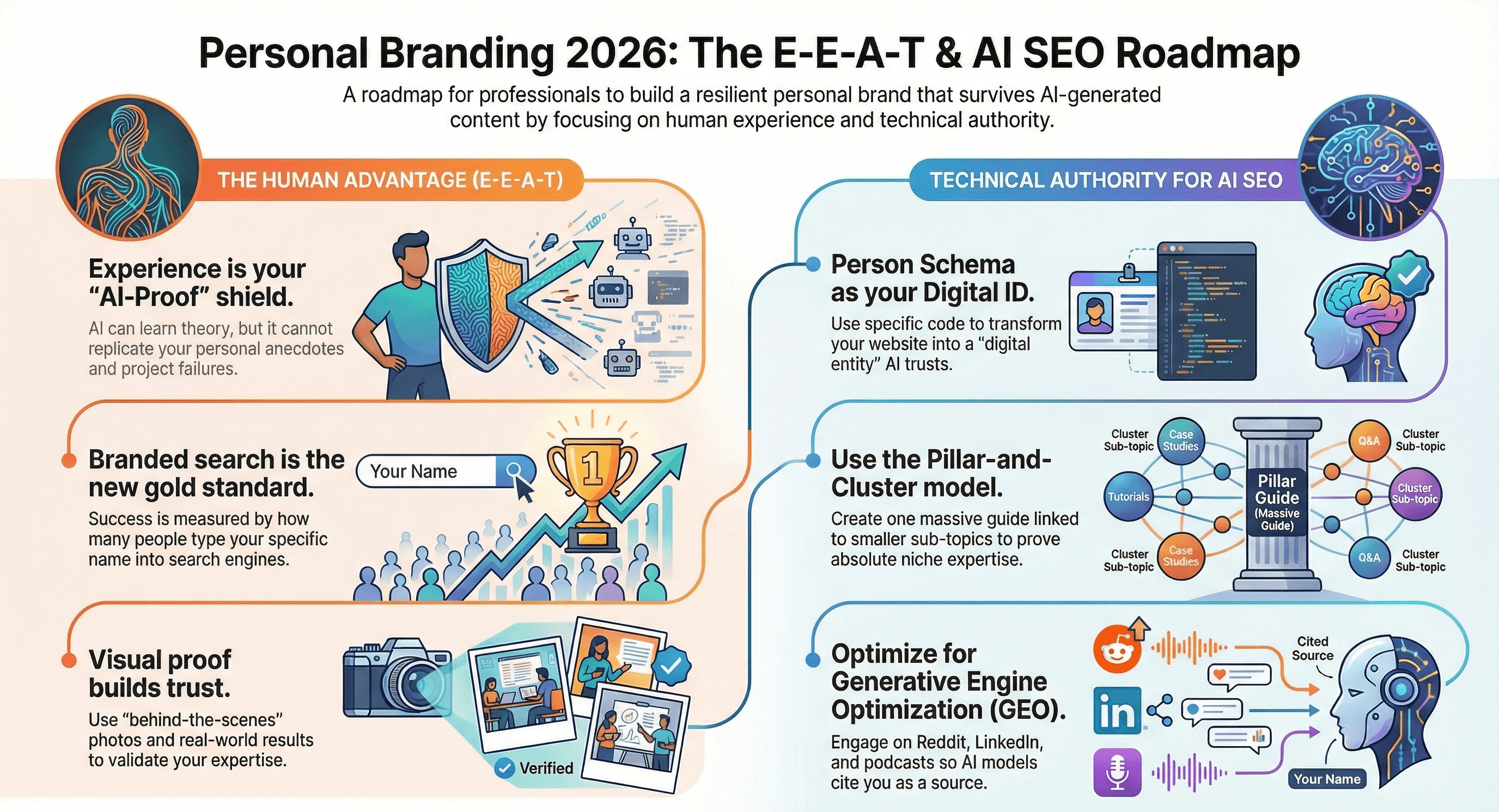
Google and other search engines today rank content through the E-E-A-T framework (Expertise, Experience, Authority, Trust). The most important letter in this acronym now is "E" for Experience.
Systems actively seek proof that you have actually done what you are writing about. Generic advice no longer passes. To prove experience, your content must include:
Anecdotes from real projects.
Behind-the-scenes photos and real results.
Admissions of mistakes and the lessons you learned from them.
When you share what you have personally experienced, you become resistant to AI competition. A machine can learn theory, but it cannot replicate your experience.
Optimization for AI Search (GEO) and Your Digital Personal Card
Search Engine Optimization (SEO) is no longer just a race for keywords. People are now receiving direct answers from AI tools like Google AI Overviews or Perplexity. For these tools to quote you as an expert, you must technically structure your identity.
This is where Person Schema markup comes into play. It is a piece of code on your website that clearly tells search engines who you are, what you know, and where you are on the internet. It transforms you from an ordinary site into a "digital entity" that machines trust.
Additionally, AI models learn from platforms where people naturally communicate. Therefore, your strategy must encompass:
Participation in expert Reddit discussions.
Sharing knowledge through posts and comments on LinkedIn.
Guest appearances on podcasts in your niche.
When others mention you on these platforms, your authority in the eyes of AI models grows.
Website Architecture that Demonstrates Expertise
Forget about isolated blog posts. To dominate your niche, use the Pillar-and-Cluster content model.
This means creating one large, comprehensive guide on a main topic (Pillar page). Then, you write a series of smaller texts (Cluster pages) that explain specific subtopics in more depth. All smaller texts link back to the main guide. This creates a strong thematic network that proves your absolute expertise to Google.
Furthermore, site speed is crucial. Core Web Vitals metrics no longer forgive slow pages or text that "jumps" while loading. A seamless user experience is a prerequisite to entering the race for ranking at all.
How Does This Work in the Domestic Market?
The market in Serbia and the Balkans has its specifics. Trust is still built around personal recommendations here, but that process has moved into the digital space. Local consumers and clients massively check reviews and follow experts on LinkedIn before making decisions.
Particularly significant potential lies in the eCommerce sector and analytics. If you manage to position yourself as an expert who understands the customer journey from the first click to purchase, you will have a clear advantage in the local market where such experts are still lacking.
What Is Your Next Step?
Building a personal brand is a marathon, not a sprint. Results come if you are authentic, technically literate, and consistent.
Ask yourself this question: If all your social networks disappeared tomorrow, how many potential clients would search for you by name on Google? If the answer is "few," it’s time to change your strategy. Your main goal in 2026 is to increase direct, branded searches.