
UX design and customer behavior
UX Design: How an Invisible Force Shapes Customer Behavior and Your Business Growth
UX basics and processes
Imagine walking into a luxury store in the city center. The door is hard to open, the shelves are scattered without any order, and the salesperson is nowhere to be seen. Even if the products on the shelves are top-notch, your first reaction will be to walk out.
In the digital world, that is bad UX (User Experience).
User experience is not just a matter of a "nice looking" website or application. It is a discipline that combines psychology, technology, and business strategy. User attention is limited, so user experience often determines whether a visitor will buy from you or from your competitor.
What exactly is UX and why is it costing you money?
UX design represents the overall experience a person has while interacting with your brand. This includes loading speed, navigation logic, tone of communication, and even how easy it is to reset a password.
When UX is bad, you pay a "friction tax." Every redundant click, every unclear sentence, and every slow page load are points where you lose money. Today's buyers do not just buy a product, they also buy simplicity. If you do not provide it to them, the competition is just a click away.
The psychology behind the click: how design changes behavior
UX also affects processes in the consumer's brain that we are not consciously aware of. There are several psychological principles that explain how we behave on a website.
1. Hick’s Law
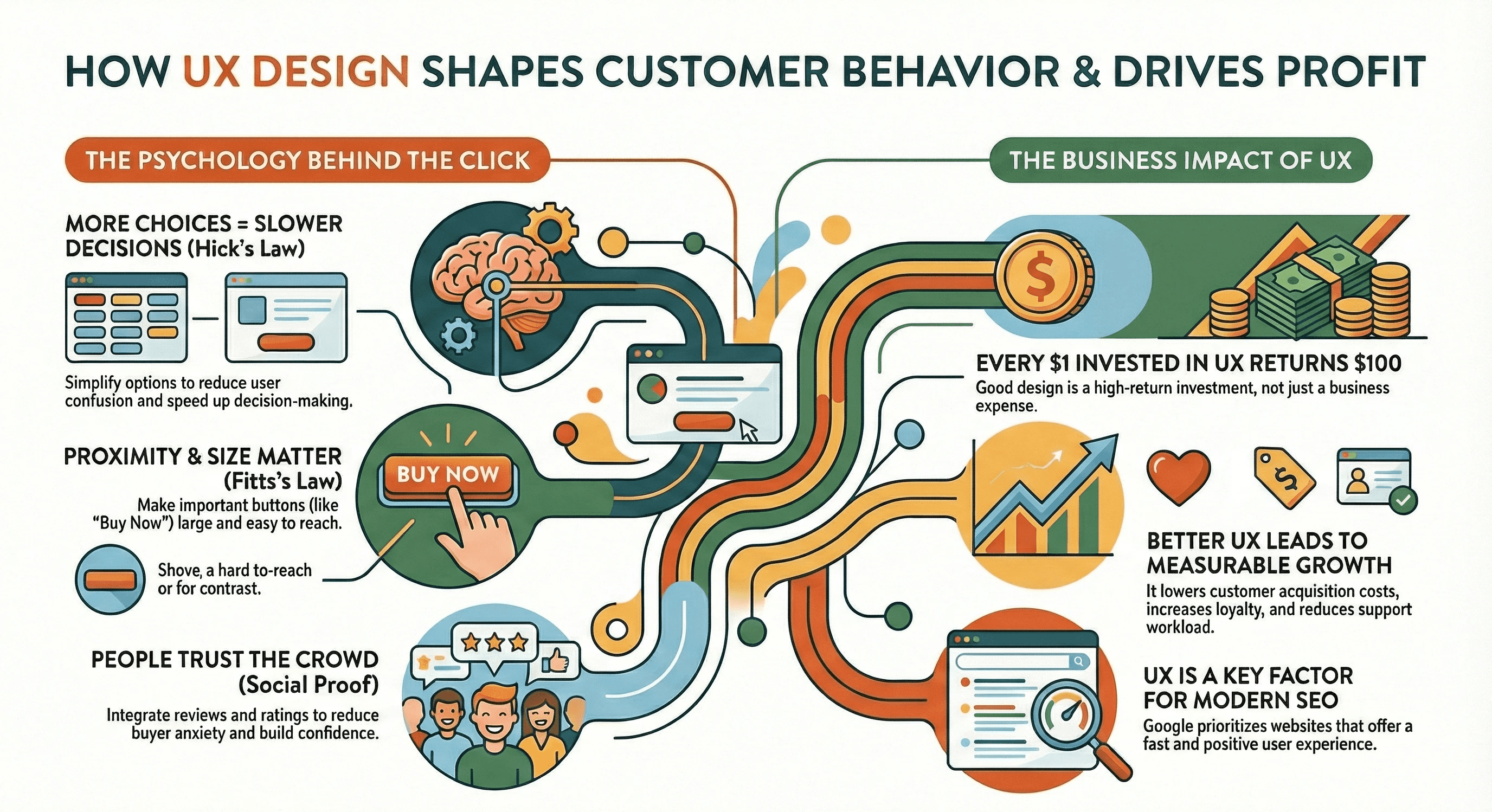
This rule states that the time required to make a decision increases with the number and complexity of choices. If you offer 20 different services at once on the homepage, it will be harder for the user to decide where to start and they will give up more easily.
An example is the Google homepage, which has not changed significantly for decades: one search box and two buttons. The user does not have to think about what to do, so the cognitive load is minimized.
2. Fitts’s Law
The time required to reach a target depends on the distance to and the size of that target. In UX, this means that the most important buttons (like "Buy Now" or "Sign Up") must be easily accessible and large enough for a thumb to easily hit them on a mobile phone.
3. Social Proof Principle
People feel more secure when they see that others have already traveled the same path. Reviews and ratings in the right places in the user flow are not just an "add-on," but a UX element that reduces uncertainty when purchasing.
The impact of UX on business results (Design ROI)
Many business owners still see design as an expense rather than an investment. I have written separately about how much skimping on design can cost, and here the more important question is how investing in UX pays off in practice.
Reduction of customer acquisition costs (CAC)
When a website is well-set up, a higher percentage of visitors become customers. This means your Google or Facebook advertising budget works more efficiently. For example, if you pay for 1,000 people to visit your website today and you get 10 sales from that, with a better UX, the same number of visitors can bring more sales, without spending an extra dinar on ads.
Increasing loyalty and LTV (Lifetime Value)
As a rule, it is easier to keep an existing customer than to find a new one. If the purchase went smoothly, there is a higher chance that the customer will return. Good UX builds trust, trust builds a habit, and habit brings revenue.
Less burden on customer support
If users find information easily and processes are intuitive, your support team receives fewer messages with questions like "Where is my order?" or "How do I change my address?". This is a direct saving in working hours and resources.
Examples that make a difference: from good to best
The impact of UX is easiest to see in companies that put user experience at the core of their product.
Amazon: 1-Click shopping
Amazon patented 1-Click shopping back in 1999. The logic is simple: every step in the checkout process is an opportunity for the customer to change their mind. When the customer does not have to go through the cart and re-enter data with every purchase, the purchase happens with far fewer obstacles. This is UX in the service of sales.
Airbnb: designing trust
When Airbnb first appeared, people were skeptical about staying in strangers' apartments. The platform therefore relied on high-quality photos and a transparent review system. Design served here as a bridge to overcome the fear of the unknown.
Duolingo: gamification as a UX strategy
Learning a language is hard. Duolingo uses UX to make it more fun. Progress bars, daily streaks, and instant feedback give the user a sense of progress and a reason to return tomorrow.
UX and SEO: how they are connected
Google doesn't just look at keywords. As part of what it calls page experience, Google documents Core Web Vitals and mobile friendliness.
If your site loads slowly or elements shift as the page loads (CLS), it can hurt your search engine ranking because Google's ranking systems use Core Web Vitals. When users immediately click "back" because they can't find their way around (Bounce Rate), Google doesn't confirm using that directly for ranking, but such sites are less read, shared, and linked. Google wants to send users where they will have a good experience. Therefore, UX design also helps SEO optimization, mostly indirectly: people stay, return, share, and link to content.
The future of UX: personalization and AI
Interfaces are increasingly adapting to the individual. With the help of artificial intelligence, websites will better predict what a user needs at any given moment. The core, however, remains the same: understanding human needs and removing obstacles.
Adapting to the local context, such as payment methods common in the country, further strengthens the connection with the consumer. Understanding local habits is often what turns a global product into a local favorite.
How to start?
You don't have to redesign the entire system right away. Start with small things:
Test with real people: observe five people trying to buy something on your website without your help. You will see problems that you don't notice yourself.
Reduce the number of fields in forms: a shorter form is easier to fill out, so fewer people abandon it halfway.
Speed up your website: a slow website ruins the impression before a visitor reads anything.
UX is not a luxury, but the foundation of doing business on the internet. If you don't care about your users' experience, they take it as a message that you don't care about them. And when anyone can publicly share a bad experience, that is a risk a serious business should not take.
A practical example is the UX/UI design of the Balkanaukcija platform.
If you want to check where your website is losing customers, get in touch with me and we will go through your case together.
Is good UX the same as a nice design?
Not necessarily. Beautiful design is aesthetics (UI), while UX is functionality and feel. A site can be very beautiful, but if the user cannot find the buy button, that design is unsuccessful. UX is about solving problems, not just beautifying.
How much time is needed to see the results of UX improvements?
I cannot promise you a deadline. When I speed up the website or simplify the checkout process, conversions may increase, or they may remain the same. I am working on making them grow, but they are influenced by many factors. Long-term effects, such as growing brand loyalty, are built gradually.
Is UX important only for large companies?
On the contrary. For small businesses and startups, UX is a way to compete with the big players. A good experience can be your key competitive advantage that attracts customers even if you have a smaller marketing budget.
How does UX affect mobile users?
Most traffic today comes from mobile devices. Mobile UX requires a different approach: a focus on the thumb-friendly zone, minimalism in text, and exceptional speed. Poor mobile UX is the fastest way to permanently lose the modern consumer.
What is the difference between UX and Customer Experience (CX)?
UX focuses on the specific interaction with the product (application, website), while CX is a broader term that encompasses all touchpoints with the brand, including customer support, physical stores, and the return process. Good UX is an essential part of excellent CX.

Senior UX/UI and product designer from Belgrade, with more than 10 years of experience. He has collaborated with clients such as MerchKing, Bex courier service, Balkan Group, Maeti, 502 Solutions, DataWiz, and many others. He holds Google and Adobe specializations and a Uxcel certification in UX/UI design.