
Vibe Coding and Design
Vibe Coding and Design: How to Get an App Without a Whole Team of Developers
AI and the future

Vibe coding is an approach to development where an application is built through conversation with an AI tool, instead of the classic line-by-line code writing. This means that someone who understands users, user flows, and design, like me, can now deliver a functional application on their own. For a small business or entrepreneur who needs an internal application, this means one person instead of an entire team, a much lower price, and a much shorter timeline. In this text, I explain what vibe coding actually is, why a designer has a natural advantage in this process, and what collaboration looks like when you entrust the creation of your application to me.
What vibe coding actually is
Vibe coding is a term that has become increasingly popular in recent years, describing a way of working where a person describes what they want to build, and the AI tool generates the code that does it. Instead of someone spending years learning programming languages, it is enough to know what they want to achieve and to be able to explain it clearly.
Tools like Lovable, Bolt, or Replit do exactly that. You tell them what you need, they give you a working application, and then through further conversation, you fine-tune the features, appearance, and logic until everything works properly. It is not magic, and it is not a replacement for serious, complex systems, but for smaller applications and internal tools, it works surprisingly well.
What was immediately clear to me as a designer is that this process resembles the design process much more than classic programming. Instead of writing code, you shape the solution through iterations. You test, look at the result, change, and test again. This is the same principle I have used to do UX design since day one.
Why a designer has an advantage in vibe coding
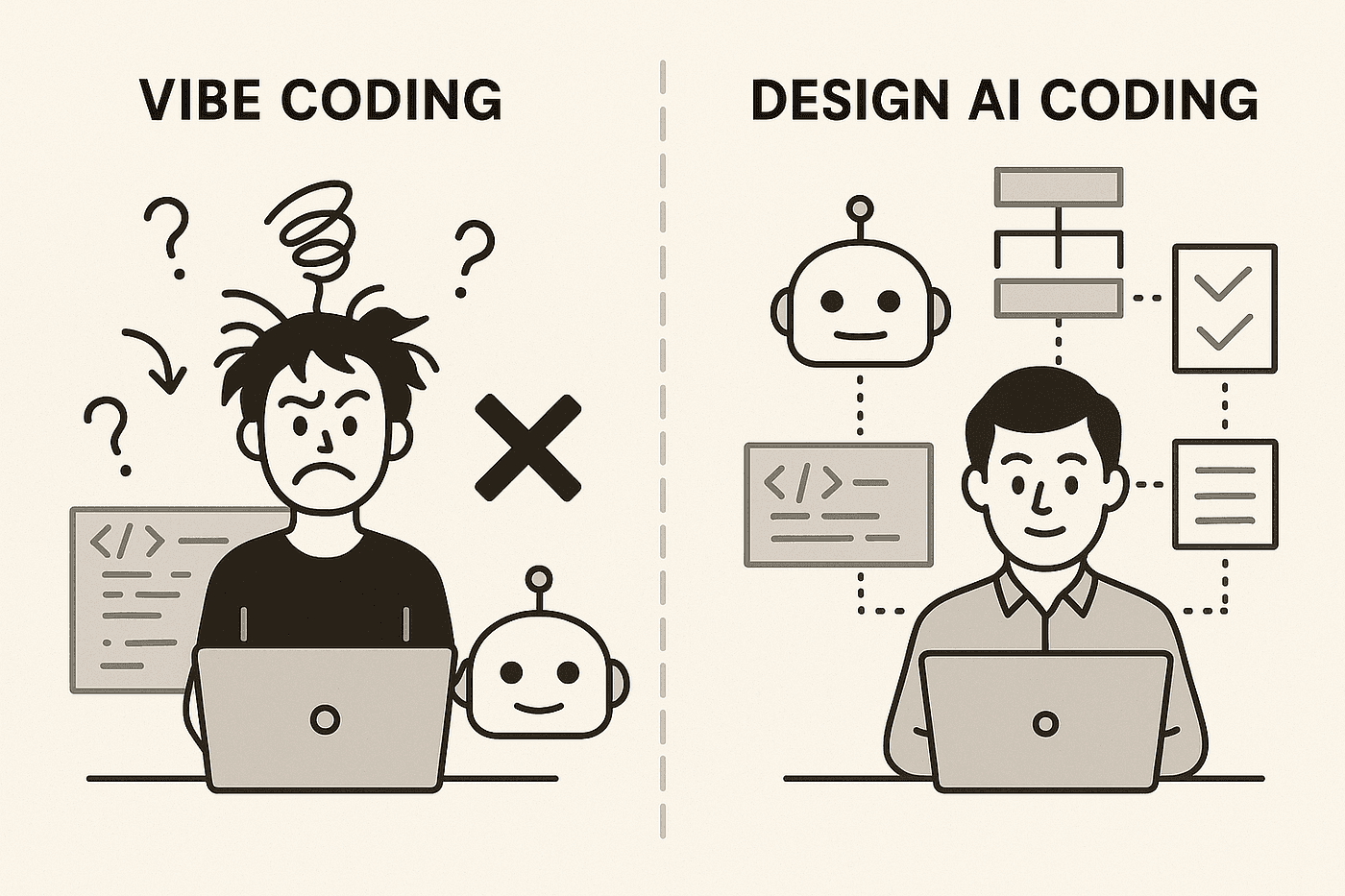
A programmer who has never thought about user experience can use vibe coding to make an application that works, but one that nobody understands how to use. A designer who has never written code can now, with the same tools, make an application that works and is easy to use.
The difference is that building an application is no longer just a technical task. The biggest part of the job is understanding what the user actually needs to do, in what order, and how to make that as simple as possible for them. That is the designer's job, not the job of someone who knows the syntax of a programming language.
When I work on an application, I first think about the user flow. Who is opening the application, what is the first thing they need, where do they most often make mistakes, and what would confuse them. Only when that part is clear do I move on to telling the vibe coding tool what to build. The result is not just an application that works, but an application that employees or clients actually love to use.
The problem small businesses face with classic application development
If you have a small business and need an internal application, say for order tracking, employee records, reservations, or your own system for working with clients, the classic path looks something like this. You look for a development team or agency, receive an offer that often exceeds your budget, wait weeks or months for the team to form, and then wait even longer for everyone to align on design, functionality, and deadlines.
Along with that, in that team, you usually have a product manager, a designer, one or two programmers, and maybe a tester. Each of these people charges for their time, and their communication with each other also consumes time and money. For a large company, that makes sense. For a small business or entrepreneur who just needs to solve one specific problem, it is often too big and expensive an undertaking.
The result is that many small businesses either give up on the idea of having their own application, or continue to work in Excel spreadsheets and paper records for years, even though a simple application would save them hours of work per week.
The solution: one person, the entire process
This is where vibe coding and design merge into something that gives me the opportunity to offer you a completely different collaboration model. Instead of hiring an entire team, you work directly with me, and I cover the entire process from start to finish.
This means that I do the research on your needs, design the user flow and the appearance of the application, and then transform that same vision into a functional application myself with the help of vibe coding tools. There is no passing of information between a designer and a programmer, no details getting lost in translation, and no waiting for the schedules of multiple people to align.
For you as a client, this means three things that are most important. First, a lower price, because you pay for the work of one person instead of an entire team. Second, a faster turnaround time, because there are no coordination steps between different people and roles. Third, consistent quality, because the same person who figured out how the application should look and work is the one who actually made it look and work that way.
Who this is an ideal solution for
This approach makes the most sense for several types of clients.
Small businesses that need an internal tool, for example, a system for tracking orders, employee scheduling, inventory tracking, or a simple CRM tailored to their way of working. They don't need an application with thousands of users; they need a tool that solves their everyday problem.
Entrepreneurs and freelancers who need a tool for their own clients, say, a portal for scheduling appointments, a simple system for project tracking, or an application that automates part of the work they currently do manually.
Smaller companies that want to test an idea before investing a larger budget in development. Instead of immediately hiring a team and spending serious money, they first get a functional version that shows them if the idea actually works in practice.
If you recognize yourself in any of these situations, this is exactly the type of project for which I am the ideal choice.
What the process of collaborating with me looks like
The process usually starts with a conversation about what you need and what problem the application needs to solve. I don't ask you what features you want, but rather what you are trying to achieve, because those are often two different things.
After that, I map out the user flow, meaning what steps exist, who does what in the application, and what happens at each step. This is the stage where things are most often discovered that would otherwise only surface once the application was already built, and then it is much more expensive to change them.
Once the flow is clear, I design the look of the application, screen by screen, so you can see exactly what everything will look like before anything is built.
Then I move on to the actual build using the vibe coding tool. The application is built in iterations; I test every feature, check if everything works as it should, and fine-tune the details.
In the end, I deliver a finished, functional application to you, ready for use, along with a brief explanation of how to use it and how to potentially upgrade it further.
When you still need a real team of programmers
It is genuinely important to say this too. Vibe coding and this model of collaboration are not the solution for every project. If you need an application with a serious security infrastructure, a large number of simultaneous users, complex integration with multiple external systems, or something that requires a specific technical architecture, then you truly need a team of experienced programmers and engineers.
My approach is excellent for internal tools, smaller applications, MVP versions, and anything that needs to solve a concrete, clearly defined problem without enormous technical requirements. If you are not sure which category your idea falls into, feel free to write to me, and I will gladly tell you honestly whether this is the right approach for you or if a classic development team would be better.
Conclusion
Vibe coding has changed who can build an application, and designers are, in my opinion, at a natural advantage in this new world, because the biggest part of the job has always been understanding users, not writing syntax. For a small business or entrepreneur, this means you can finally get an application that looks good, works properly, and doesn't cost you as much as hiring an entire development team.
If you have an idea for an internal application or tool that would make work easier for you or your team, get in touch with me. Let's go through your idea together and see if I can turn it into a finished application for you.